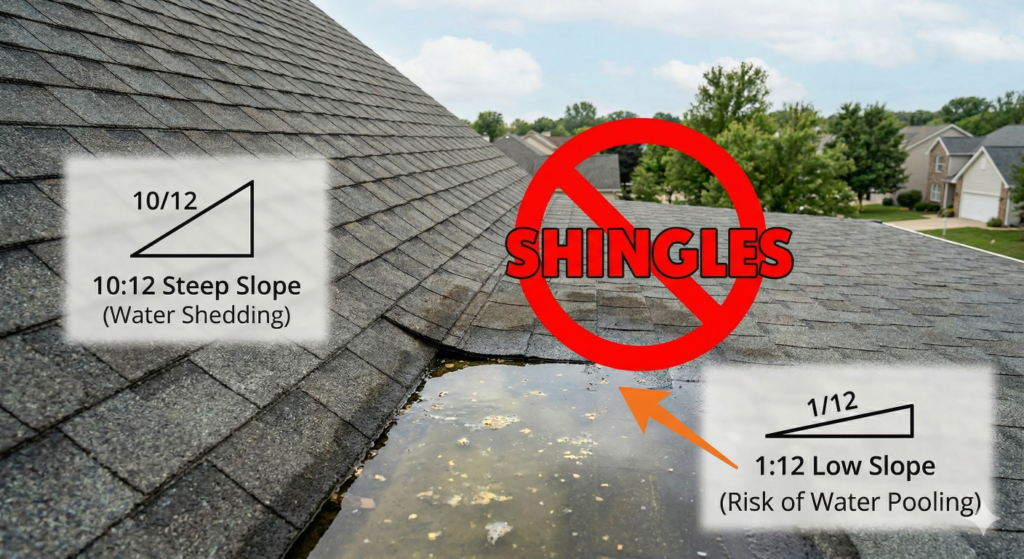
If you’re looking at your home’s roof and noticing a section that looks a little “flatter” than the rest, you might be tempted to just run the same asphalt shingles across the whole thing for a uniform look. However, considering the specific challenges of shingles on low slope roof, it’s essential to approach this with caution.
Understanding Shingles on Low Slope Roof
Stop right there. Installing steep-slope products—like standard asphalt shingles—on a low-slope roof (anything less than a 3:12 pitch) is a recipe for expensive repairs. Here is why gravity isn’t on your side when the angle gets shallow, especially when dealing with shingles on low slope roof installations.
1. The Physics of “Hydrostatic Pressure”
Steep-slope roofing is designed to be water-shedding, not waterproof. Shingles work like scales on a fish; they rely on a steep angle to pull water down and off the roof quickly using gravity.
When the pitch drops below 3/12 (meaning the roof rises less than 3 inches for every 12 inches of horizontal run), water doesn’t rush off. Instead, it lingers. This creates hydrostatic pressure, where standing water is pushed backward under the laps of the shingles.
2. Capillary Action: The Stealthy Leak
Water has a funny way of defying gravity through capillary action. In a low-slope environment, moisture can be “sucked” upward between the overlapping layers of shingles.
- On a steep roof: The water moves too fast for this to happen.
- On a low slope: The water sits long enough to find its way around the nails and into your plywood decking.
3. Wind-Driven Rain and Ice Dams
When considering the minimum roof pitch for shingles, most manufacturers warn against anything below a 2:12 or 4:12 slope. This is because standard shingles have a “wind uplift” rating based on the assumption that wind will hit the face of the shingle and blow over it.
On a low slope roof, drainage issues become a major concern. Wind can easily catch the edges of the shingles and drive rain directly underneath them, leading to a shingle roof leaking on a low slope area that otherwise looks “fine” to the naked eye.
Furthermore, these flatter areas are prime real estate for ice dams. Since snow melts more slowly on a low slope roof, water backs up under the shingles, freezes, expands, and rips the sealant strips apart. This is a primary reason why shingles fail on flat roofs—they simply aren’t designed to handle standing water or ice pressure.
What are the alternatives?
If your roof pitch is between 2:12 and 4:12, you can sometimes use shingles, but only with a double layer of underlayment or a specialized ice and water shield covering the entire surface. However, if you are under 2:12, shingles are a hard “no” from most manufacturers and building codes.
Better options include:
- EPDM (Rubber): Extremely durable and comes in large sheets to minimize seams.
- TPO/PVC: White reflective membranes that are heat-welded together to create a single waterproof “pool liner” for your roof.
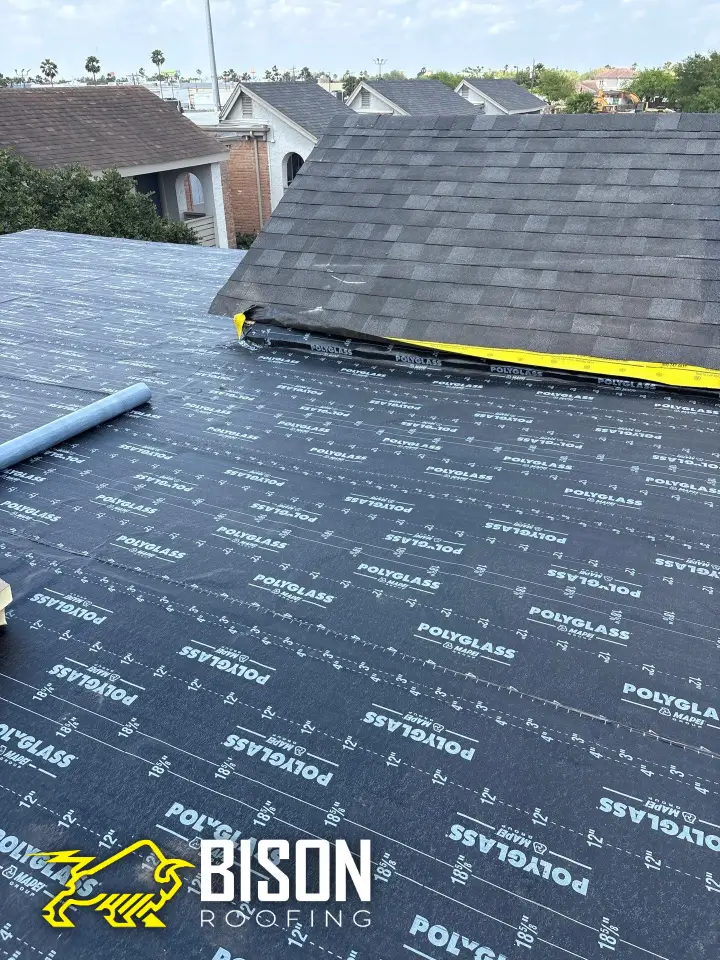
- Mod-Bit (Modified Bitumen): A modern take on “built-up” roofing that uses layers of asphalt-impregnated fabric. Matching colors are available in Modified Bitumen systems, making it the go-to alternative if you want your low-slope roofing to blend perfectly with your asphalt shingles. Here is a link to Polyglass Self Adhered System.
The Bottom Line
Installing shingles on a low slope roof might look fine on day one, but it voids most manufacturer warranties and almost guarantees a leak within the first five years. Don’t risk your home’s structural integrity on an improper installation. At Bison Roofing, we specialize in identifying these “pitch pitfalls” and providing long-term, waterproof solutions that protect your investment.
Do it right the first time with a membrane system or a color-matched Modified Bitumen roof designed to handle standing water. Whether you need a repair or a full replacement, our team has the expertise to ensure your low-slope sections are as durable as the rest of your home.
Ready to Protect Your Roof?
Don’t wait for the next storm to find a leak. Contact Bison Roofing today for a professional evaluation.
Call us at 210-888-9646 or