
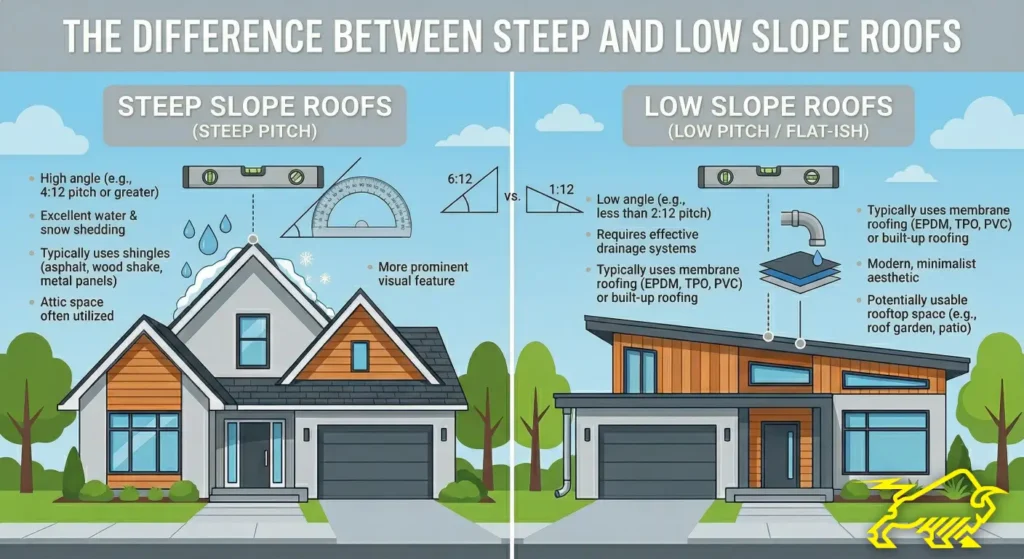
How do you choose the best roofing system for your property? There are several factors to consider, among them the specific roof type suitable for your needs.
When you look at your home, you probably just see “the roof.” However, to a roofing professional, your home is likely a combination of different planes, angles, and “pitches.”
Understanding the difference between a steep slope and a low slope is the first step in ensuring your home stays watertight for decades. Using the wrong material on the wrong angle is the #1 cause of premature roof failure. When considering roofing options, it’s essential to weigh the differences between steep slope vs low slope.
Understanding Steep Slope vs Low Slope
Before we compare the two, we have to understand how we measure them. In the industry, we use a “ratio” called pitch.
A 4/12 pitch means that for every 12 inches the roof runs horizontally, it rises 4 inches vertically.
- Steep Slope: Generally defined as any pitch 4/12 or higher.
- Low Slope: Generally defined as any pitch between 2/12 and 4/12.
- Flat Roof: Technically a “low slope” as well, usually anything below 2/12.
1. Steep Slope Roofing (The Standard)
Most residential homes feature steep-slope sections. These are designed to be “water-shedding” systems.
- Primary Goal: To use gravity to pull rain and snow off the roof as quickly as possible.
- Common Materials: Asphalt shingles, clay tiles, slate, and standing seam metal.
- The Benefit: Because water moves quickly, these roofs are less prone to leaks caused by “pooling” water. They also offer the most “curb appeal” because the materials are highly visible from the street.
2. Low Slope Roofing (The Challenge)
Low-slope areas are often found over porches, home additions, or modern architectural designs. These areas cannot rely on gravity alone; they require a “waterproof” membrane rather than just a “shedding” material.
- Primary Goal: To create a continuous, sealed barrier that can handle water sitting on the surface for short periods.
- Common Materials: TPO, EPDM (Rubber), and Modified Bitumen.
- The Benefit: Low-slope systems allow for unique home designs and can often be more accessible for maintenance.
Why You Can’t Always Use Shingles
A common mistake is trying to “match” the low-slope section of a house to the steep-slope section by using the same shingles.
As we discuss in our deep dive on [The Pitch Problem: Why Shingles Fail on Low Slopes], shingles are not a waterproof seal. On a low angle, water can actually travel upward between shingle layers via capillary action. To keep your home safe, low-slope sections require specialized membranes.
The Best of Both Worlds: Modified Bitumen
If you are worried that a low-slope membrane will look “industrial” next to your beautiful shingles, there is a solution. Modified Bitumen systems come with granulated surfaces. These granules can be color-matched to your asphalt shingles, providing a seamless look while maintaining a 100% waterproof seal.
The Bison Advice: Expert Guidance Matters
Choosing the right material for the right pitch is a science. At Bison Roofing, our focus is on the customer experience—which starts with honesty. We won’t install a product that we know will fail just to make a sale look “uniform.”
We evaluate every angle of your roof to ensure the materials used are manufacturer-approved and warranty-protected.
Not sure what your roof pitch is?
Let us take the guesswork out of it. Contact Bison Roofing today for a professional evaluation and a clear, honest proposal for your project.
[Schedule Your Free Consultation & Proposal]
1. Can you put shingles on a 2/12 pitch roof?
Technically, yes, but with major conditions. Most building codes and manufacturers (like GAF or CertainTeed) require a double layer of underlayment or a full coverage of ice and water shield for pitches between 2/12 and 4/12. However, installing shingles on anything lower than 2/12 is a violation of most manufacturer specs and will likely void your warranty.
2. What is the best roofing material for a low-slope roof?
For residential homes where aesthetics matter, Modified Bitumen is often the best choice because it offers granulated colors that match your existing shingles. For maximum durability and water tightness, membrane systems like TPO or EPDM (rubber) are superior because they are heat-welded or glued to be 100% waterproof, unlike shingles which are only “water-shedding.”
3. How do I know if my roof pitch is too low for shingles?
A “low slope” is generally defined as a roof that rises less than 4 inches for every 12 inches of horizontal run (4:12). If you notice water sitting on your roof for more than 48 hours after a rain, or if your roof looks nearly flat to the naked eye, it is likely a low-slope surface that requires specialized materials instead of standard asphalt shingles.


Genaro Montelongo Jr. is the Founder of Bison Roofing and an Owens Corning Platinum Preferred Contractor with 20+ years of experience. While he is an expert in Texas storm restoration and complex roofing systems, Genaro’s primary focus is elevating the customer experience—ensuring every homeowner receives clear communication, honest guidance, and a seamless process from start to finish.